Find gaps in your asset inventory
Find websites and servers that dropped off the list, for example after a change of staff, and confirm whether your organization should manage them
What you getAn asset list backed by ownership evidence
Attack Surface Management SENTRIX ASM
Find websites and servers missing from your inventory,
and manage risk priorities, owners and fix status in one place
ASM: attack surface management, finding and managing the points an outside attacker could target
For security and IT teams at companies and public institutions whose external assets are spread out
Scope at a glance Service diagram
We work within the scope where asset ownership and authorization to test have been confirmed.
01 / What changes with ASM
Find websites and servers that dropped off the list, for example after a change of staff, and confirm whether your organization should manage them
What you getAn asset list backed by ownership evidence
Check the risk evidence for each asset and set review priorities
What you getRisk evidence and review priorities
Track owners, fix records and recheck status, and use point-in-time results for internal reports
What you getOwner and progress status, plus evidence for reports
02 / Workflow
Assessment results connected to the owner's follow-up work
Start from your domains
and find linked websites and servers
Confirm which assets are yours,
then sort risks and review order
Assign owners
and record progress and fixes
Mark the check status after each fix
and keep point-in-time results
Fix records and recheck results are kept separate Remaining checks are managed without assuming automatic fixes or completed verification.
03 / Product screens
Easier-to-read versions of real product screens, built on synthetic data. The original screen (Korean interface) can be opened below each example.
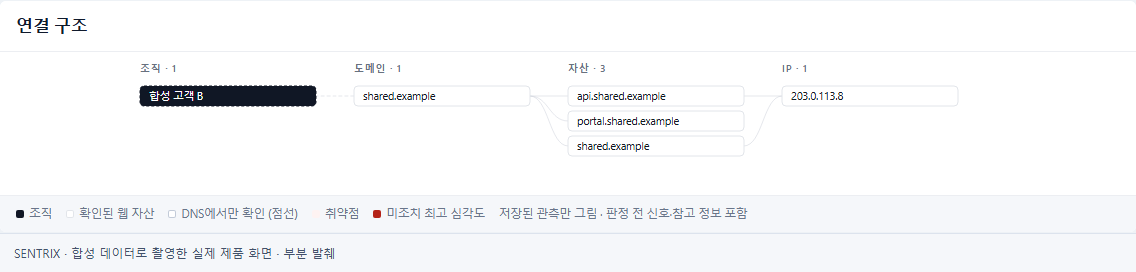
See how domains, websites and servers are connected and review what needs managing
Relationships from the original screen · rebuilt with synthetic data
Organization under management
Starting point of the relationships
Address that several assets connect to
An illustrative example that copies the relationships from a published synthetic screen. A link between assets does not by itself confirm ownership or mean a vulnerability has been verified.
See the domains managed for each organization
Websites and APIs linked to each domain
See the IP each asset connects to
Manage internal report items and follow-up review targets together
Review list from the original screen · rebuilt with synthetic data
shared.example
api.shared.example
Categories and status as shown on the original synthetic screen when it was made. This example does not show any real customer's vulnerabilities or current operating status.
See each finding and the asset it affects
See who is responsible and where each item stands
When each result was last checked
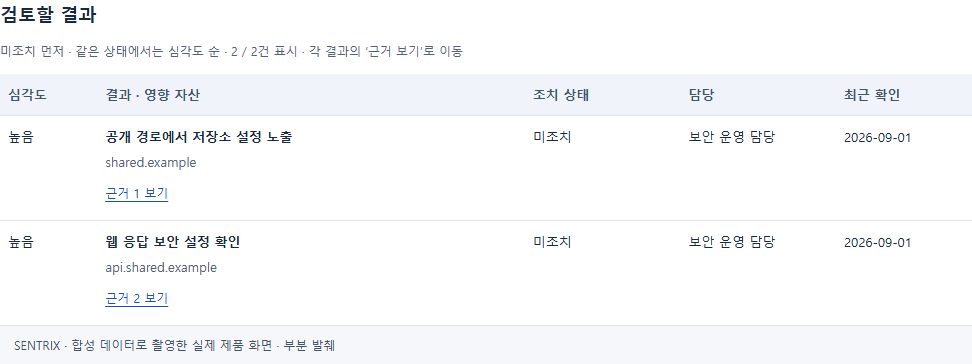
An archived report shows the results as of when it was made. Review later changes together with the latest check results.
04 / Services by purpose
Check the status of a website you enter
Manage assets and risks exposed outside your organization
Verify whether a specific service can actually be attacked
Some discovery and check items may overlap. Scope is set by what you manage and the deliverables you need.
05 / Engagement options
Quote after consultation
We agree on target assets, check frequency, operations support and recheck scope.
See your current external exposure and get material for internal review
Check how well it fits your organization's assets and the owners' work
Track changes in external assets and each owner's fix and recheck status
If the detailed scope is not set yet, we can advise based on your current situation.
Attack surface management (ASM) finds the domains, servers, websites and APIs visible from the internet, puts them in a list, and regularly rechecks new or changed assets and their risks. Because it deals with externally exposed assets, it is also called EASM. Vulnerability assessment and penetration testing examine a defined target in depth, so the two are used together: ASM picks out high-risk assets and hands them over as assessment scope.
We check the ownership evidence for assets found from your primary domain and within the authorized scope. Some assets may not be visible from outside or may be hard to confirm, so discovered candidates are kept separate from assets with confirmed ownership.
ASM tracks owners, fix records and recheck status. Actual configuration changes, operations support, and the number and scope of retests are set in the contract. A fixed status on its own does not mean the asset has been verified as safe.
Impersonation and lookalike domains for agreed brands can be included in the external threat check. Which brands and targets to check is decided in consultation. Deeper testing is agreed separately after confirming the targets, authorization and operational impact.
For your team's internal review
Benefits → Product screens → Engagement options
PDF (Korean) · Revised Sep 17, 2026 · Real product screens with synthetic data